An audiobook trial and an ongoing membership solve different problems. A trial is mainly a short, controlled way to test whether a service fits your listening habits, catalogue preferences and payment comfort. A membership is a recurring commitment that works best when you expect to use its benefits regularly.
For UK readers, the sensible comparison is not simply “free versus paid”. Compare the live checkout terms available to you, how often you realistically listen, whether you prefer access to a catalogue or credits for individual audiobooks, and how easily you can stop before a renewal. Prices, trial lengths, app-store billing and regional availability can vary, so check the terms shown on your own checkout path before committing.
How to judge audiobook trial and membership value
Start with the outcome you want. If you are unsure whether a service has the narrators, titles or listening experience you want, a trial can help you assess fit before paying for another billing cycle. If you already know you listen often and value a predictable monthly benefit, an ongoing membership may be easier to justify.
Use four questions to compare plans:
- How many audiobooks or listening hours are you likely to use before the next renewal?
- Do you need access to ebooks as well as audiobooks, or are audiobook credits your priority?
- Does the catalogue include the authors, formats and titles you are most likely to choose?
- What do the current UK checkout page and cancellation instructions say about price, duration, payment route and renewal?
A credit-based plan and an access-based subscription should not be treated as interchangeable. A credit may be useful when you want to select individual audiobooks, while catalogue access depends on what remains available under that subscription. The better value is the option whose rules match your actual reading pattern—not the one with the most eye-catching introductory offer.
When a free trial is the better-value choice
A free trial is most useful when it answers a real question before you take on a recurring charge. For example, you may want to confirm that the app works well on your devices, that your preferred titles are available, or that you will actually make time to listen.
Scribd’s subscription guidance says that a website trial asks you to provide a credit or debit card, PayPal or Google Pay; it also says you can cancel at any time. The same guidance states that the subscription automatically renews when the free-trial period ends unless you cancel, with billing occurring within 24 hours before the end of the trial. Scribd subscription guidance [Evidence: ev_5f2dd547c216f4b7]
That makes a trial a good-value evaluation tool when you set a reminder immediately, plan what you will test and are comfortable entering the required payment details. It is less useful if you begin it during a busy period and do not expect to listen enough to judge the service.
Do not assume that every provider has the same trial duration, payment method or app-store process. Scribd notes that app users may be prompted to start a trial through the App Store or Google Play, while its website flow uses the payment options described above. Check the route you are using rather than relying on a general comparison page. Scribd subscription guidance [Evidence: ev_5f2dd547c216f4b7]
Trial pitfalls to check before signing up
AI-generated generic editorial illustration — not a retailer product photo and does not depict the reviewed product or service. Make the key pre-sign-up checks immediately scannable without implying provider-wide terms beyond the evidence.
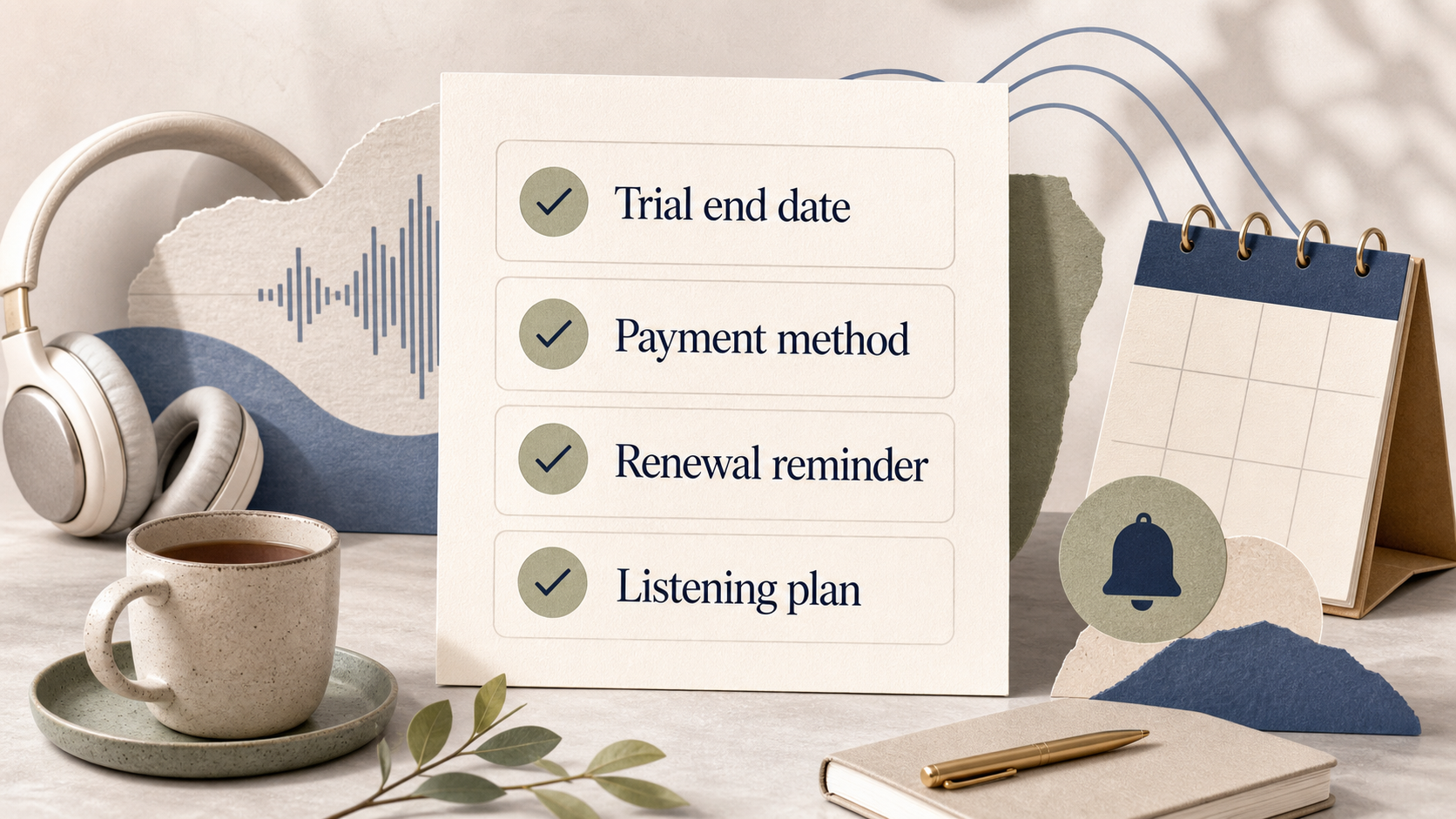 An apparently free trial can lose value in three common ways: you overlook the renewal date, you do not use the service enough to assess it, or the available titles and formats do not fit your habits.
Before starting, note the exact trial end date shown at checkout and add a reminder early enough to review or cancel. Payment details and automatic renewal are not small-print details: Scribd’s website guidance says payment information is required to begin the trial and that the subscription renews automatically after the trial expires unless cancelled. Scribd subscription guidance [Evidence: ev_5f2dd547c216f4b7]
Also check whether you are subscribing through a website, an app store or another payment route. The cancellation path, displayed currency, available payment methods and regional catalogue can depend on that route. Treat the checkout page as the current source of truth.
Finally, give the trial a job. Queue a few titles, test your normal listening device and decide whether audiobook access alone is enough for you. If you also need ebooks, a specific narrator or a narrow genre, test those needs before the renewal decision rather than after it.
How ongoing audiobook memberships can create value
An ongoing membership can be worthwhile for a regular listener when its recurring benefit is likely to be used consistently. It can also reduce the need to make a new purchase decision each month, provided the plan’s credit, cancellation and catalogue rules suit you.
Libro.fm describes its monthly membership as one audiobook credit each month in exchange for an automatic monthly charge to a credit card. Its annual membership provides 12 audiobook credits upfront in exchange for an automatic annual charge. Libro.fm membership guidance [Evidence: ev_6e83c5fb89104d88]
The details matter as much as the headline frequency. Libro.fm says its audiobook credits never expire and may be used on gifts. It also says members receive 30% off additional à la carte audiobook purchases and access to member-exclusive sales. Libro.fm membership guidance [Evidence: ev_6e83c5fb89104d88]
For a listener who finishes audiobooks regularly, retained credits may make the membership feel less wasteful than a model where unused monthly access simply lapses. Libro.fm further states that members may cancel at any time and keep their audiobooks and unused credits. Libro.fm membership guidance [Evidence: ev_6e83c5fb89104d88]
However, credit flexibility is not unlimited title access. Libro.fm notes that publisher restrictions can mean certain audiobooks cannot be purchased with credits or are unavailable in a reader’s region. Libro.fm membership guidance [Evidence: ev_6e83c5fb89104d88]
Avoid turning these features into a blanket UK savings claim. Confirm the current price for your location and whether the titles you want can be redeemed before choosing a plan.
Membership trade-offs: monthly flexibility versus annual commitment
Monthly membership usually offers more cash-flow flexibility: you can reassess your listening habit more often and avoid paying far ahead for uncertain use. Annual prepayment can make sense only when you are confident that 12 credits upfront fit both your budget and likely listening volume.
Libro.fm’s annual plan provides 12 credits upfront, while its monthly plan provides one credit each month. Both are described as automatic charges to the member’s credit card, at annual and monthly intervals respectively. Libro.fm membership guidance [Evidence: ev_6e83c5fb89104d88]
Retained credits can soften the risk of falling behind: Libro.fm says unused credits do not expire and are kept after cancellation. Libro.fm membership guidance [Evidence: ev_6e83c5fb89104d88] But this does not remove every trade-off. Your desired audiobook may still be restricted by a publisher or unavailable in your region, according to Libro.fm. Libro.fm membership guidance [Evidence: ev_6e83c5fb89104d88]
Keep ownership and access separate in your comparison. A credit used to obtain an audiobook, and an access subscription that lets you listen while subscribed, can create different kinds of value. Check exactly what you retain after cancellation rather than assuming one provider’s rule applies to another.
An annual plan is therefore not automatically better value. It is a larger commitment that needs stronger evidence from your own likely usage and the live terms you can accept.
A practical UK reader checklist before choosing
Use this checklist before beginning a trial or taking out a membership:
- Estimate real listening volume. Think about the next one to three months, not an idealised year. Occasional listeners may benefit more from a controlled trial or pay-as-you-go purchases; frequent listeners may find recurring credits easier to use.
- Choose the benefit type. Decide whether you want flexible catalogue access, credits for selected audiobooks, or a service that also meets your ebook needs. Do not assume an audiobook plan includes the same ebook access as another subscription.
- Check the titles first. Search for the authors, narrators and genres you actually plan to hear. Where credits are involved, confirm that the specific title is eligible and available in your region; Libro.fm says publisher and regional restrictions can apply. Libro.fm membership guidance [Evidence: ev_6e83c5fb89104d88]
- Read the live UK checkout. Record the displayed price, trial duration, next renewal date, billing interval and payment route. Do not infer UK terms from another country’s offer.
- Find cancellation instructions before paying. Scribd says website subscribers can cancel at any time, while its guidance also makes clear that a trial renews automatically unless cancelled. Scribd subscription guidance [Evidence: ev_5f2dd547c216f4b7]
- Set a reminder immediately. Put it before the stated renewal point, then decide based on actual listening and catalogue fit.
For an occasional listener, the safest value test is usually a trial with a clear reminder and a short list of titles to test. For a regular credit user, compare the expected number of credits you will use with the current terms and your willingness to commit monthly or annually. For readers who need both ebooks and audiobooks, make format coverage a first filter rather than an afterthought.
The final decision should be conditional: choose the plan that you will use, can cancel confidently and can verify on today’s checkout page.
Frequently Asked Questions
Do audiobook free trials renew automatically if I do nothing?
They can. Scribd’s website subscription guidance says that, after its free-trial period expires, the subscription automatically renews unless cancelled, with billing within 24 hours before the end of the trial. Check the renewal wording and date on the provider and payment route you use, as terms may differ by service or platform. Scribd subscription guidance [Evidence: ev_5f2dd547c216f4b7]
Can I keep unused audiobook credits after cancelling a membership?
It depends on the provider. Libro.fm says members can cancel at any time and keep their audiobooks and unused credits; it also says credits never expire. Do not generalise this policy to other services without checking their current terms. Libro.fm membership guidance [Evidence: ev_6e83c5fb89104d88]
Is an annual audiobook membership always better value than paying monthly?
No. An annual plan may suit a reader who expects to use the upfront credits and is comfortable with the larger commitment, but it is not automatically the better option. Libro.fm’s annual membership supplies 12 credits upfront, whereas its monthly plan supplies one credit each month. Compare your budget, expected usage, current local price and title availability. Libro.fm membership guidance [Evidence: ev_6e83c5fb89104d88]
What should UK readers check before entering payment details for a trial?
Check the live checkout price and currency, trial end date, renewal date, payment route, cancellation instructions and catalogue availability. Scribd says its website trial requires a payment method and renews automatically unless cancelled; its app flow may instead use the App Store or Google Play. Scribd subscription guidance [Evidence: ev_5f2dd547c216f4b7]
Before you start, use the Compare audiobook subscription options guide to shortlist plan types, then use the Review cancellation steps guide before any renewal date passes.
Related reading
- Best audiobook subscriptions in the UK: evidence-led choices for different listening habits
- Libro.fm UK review: who it suits, independent-bookshop model, and who should skip it
- How to choose an audiobook subscription in the UK for your listening habits
- How to identify genuine ebook and audiobook subscription deals without overlooking the terms
Editorial information: About our editorial team · Read our editorial policy · Read our affiliate disclosure.